Understanding Reinforced Soil Wall (RS Wall) Technology
A Reinforced Soil Wall (RS Wall), also known as a Mechanically Stabilized Earth (MSE) Wall, is an advanced retaining structure that combines compacted soil with engineered reinforcement materials to create a stable, durable, and cost-effective earth retention system. Reinforced Soil Walls are widely used in modern infrastructure projects because they provide excellent structural performance, faster construction, and long-term reliability compared to conventional reinforced concrete retaining walls.
By integrating layers of geosynthetic reinforcement or steel strips within compacted backfill soil, an RS Wall forms a composite structure capable of supporting heavy loads while resisting lateral earth pressures. This innovative technology has become the preferred solution for highways, railways, bridge approaches, industrial developments, and large-scale infrastructure projects worldwide.
How Does a Reinforced Soil Wall Work?
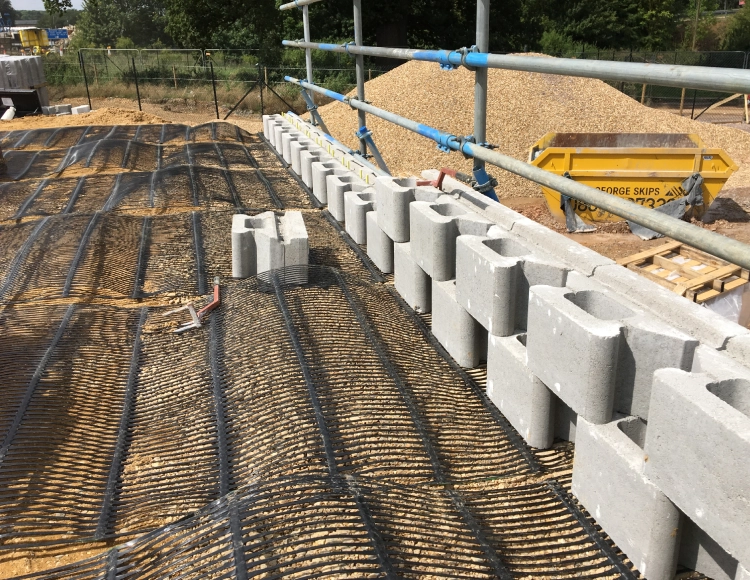
A Reinforced Soil Wall works by strengthening the soil mass using horizontal layers of reinforcement placed at predetermined intervals within compacted backfill. The reinforcement bonds with the surrounding soil through friction and mechanical interaction, creating a reinforced soil block that behaves as a single, stable structure.
The wall facing—typically made from precast concrete panels, modular blocks, or wrapped geosynthetics—provides surface protection, structural integrity, and an attractive architectural finish while retaining the reinforced soil mass behind it.